BSO Appoints Dame Konga Sergeivitzky as New Music Director
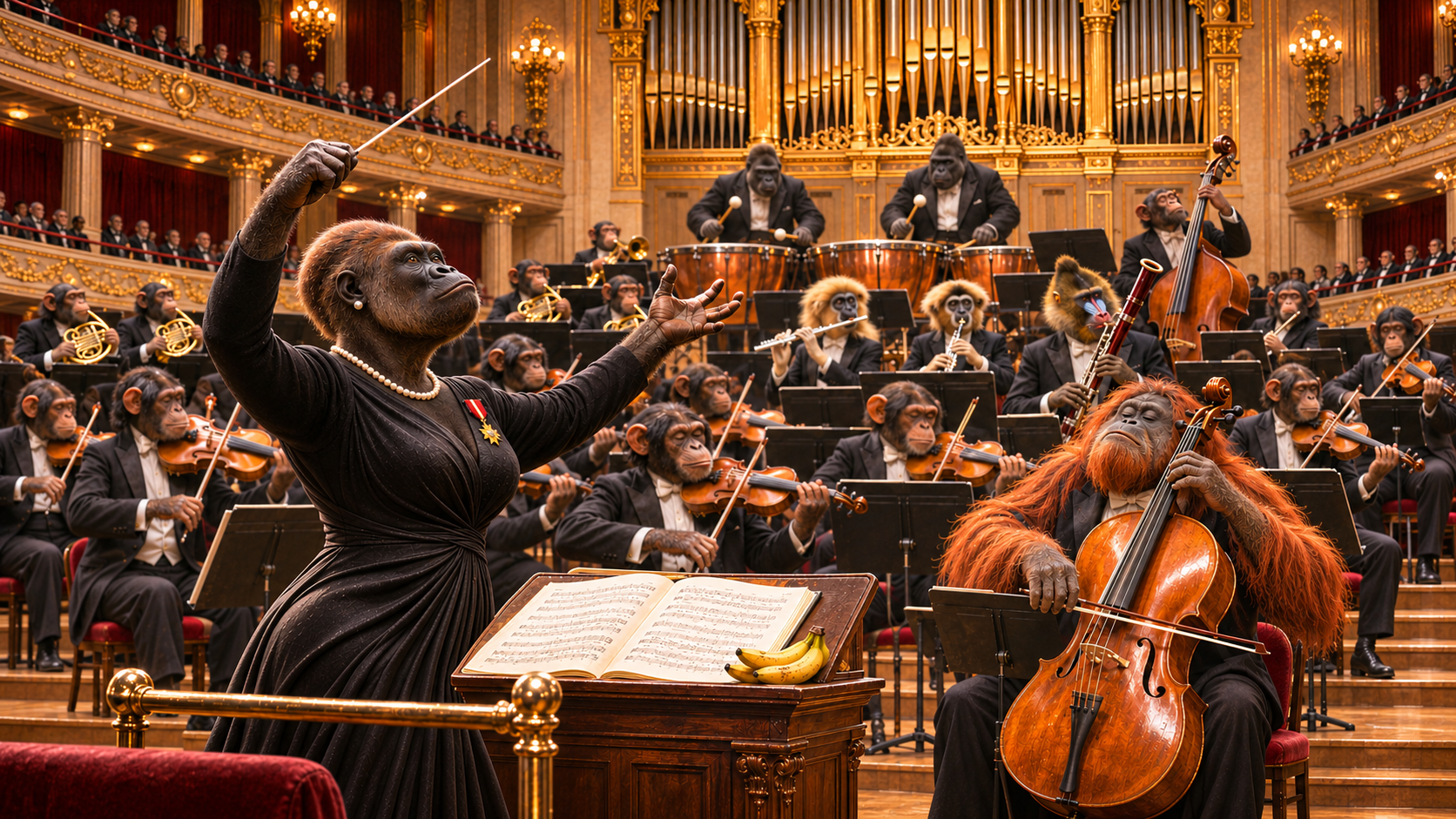
Dora Doppelgänger, the first openly transhuman president of the BSO, has announced the appointment of Dame Konga Sergeivitzky as music director of the renowned orchestra effective September 1, 2027.
Sergeivitzky, a lowland African gorilla, was was made a dame last year by King Charles for her commitment to nonhuman music. The British monarch said he conferred the honor on Sergeivitzky in recognition both of her fight against speciesism in classical music and of her excellence in the use of nontraditional instruments such as hoots and hollers, teeth gnashing, and rhythmic chest thumping.
In announcing the appointment, Doppelgänger emphasized that Sergeivitzky was not only the first nonhuman primate to lead the BSO but also its first female music director.
The incoming maestra has announced, through an interpreter, that her programming will set new standards of inclusivity and reach out to communities not previously served by the BSO. Some of the compositions that will mark her inaugural season include:
| Composition | Composer |
|---|---|
| The Rite of Swing | Igor Stravervet, vervet monkey |
| The Banana Variations | Johann Sebastian Macaque |
| Concerto for Left Foot | Maurice Ravlemur |
| Songs Without Humans | Felix Mendrilsohn, mandrill |
| Four Last Screeches | Richard Straut |
| The Well-Tempered Chimp | Johann Sebastian Macaque |
| Pictures at a Defecation | Modest Mussorgorilla |
| The Rake’s Grooming | Igor Stravervet |
The first season will conclude with Gustav Mahowler’s Symphony of a Thousand, performed by eighteen howler monkeys.
No human musicians will be harmed during the transition. Working with accredited conservatories, the orchestra will gradually reintroduce them into the community. Those unable to adapt will be placed in teaching positions. “Their severance package would, of course, be peanuts,” said Doppelgänger.
The nonhuman primate community greeted the announcement with howls of approval. Several prominent silverbacks immediately pledged substantial quantities of fruit to the orchestra’s endowment. Attendance at the announcement rose sharply, although ticket revenue was negligible, as most of the new audience entered through the roof. The board hailed the success of its outreach program.
The soon-to-be-replaced human musicians condemned the decision as an assault on artistic standards, seniority, and the pension fund. The principal cellist said he had devoted forty years to mastering an instrument that his replacement was now eating. The concertmaster demanded blind auditions, but management explained that these would disadvantage candidates who could not resist removing the screen.
The union initially opposed the appointments, then withdrew its objection when the new players agreed to pay dues. Several departing musicians admitted that the new conductor’s rehearsal technique-grunting, gesticulating, and baring his teeth-would require little adjustment.
Doppelgänger assured subscribers that the orchestra’s commitment to excellence remained unchanged, although excellence itself was under review. Asked whether the board would also be replaced by nonhuman primates, she dismissed the suggestion. “Running a major cultural institution requires judgment, financial responsibility, and a clear understanding of its purpose.” At this, Dame Konga laughed for the first time.
If you’re wondering what the genesis of the above nonsense was read this article: The board of the Boston Symphony Orchestra voted to terminate its contract with conductor Andris Nelsons.
Comments
Loading