Christmas in Music: Memory, Wonder, and Tradition
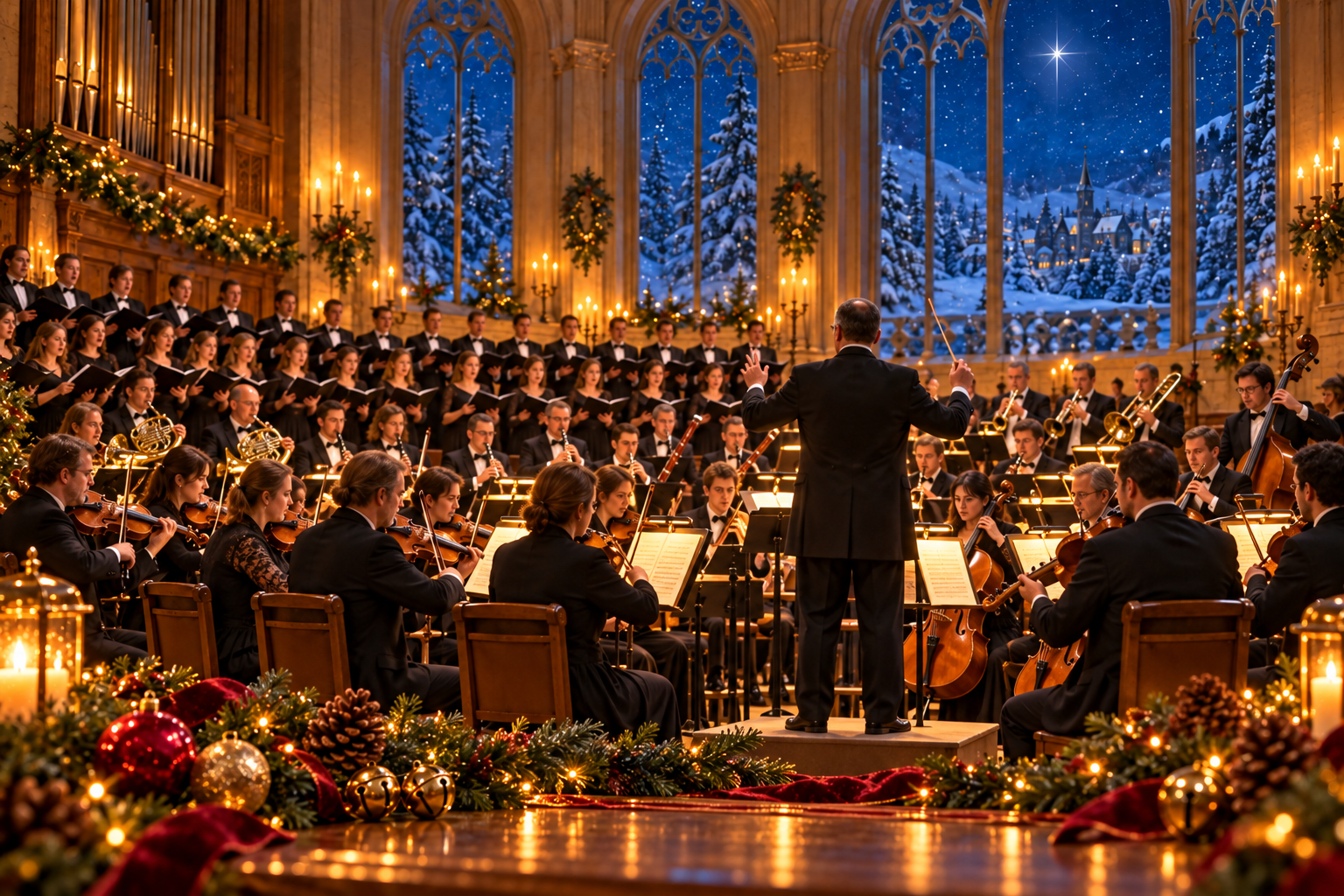
Below are the program notes I wrote for the December 1, 2026 Holiday Concert by the Lubbock Symphony Orchestra. Tickets can be purchase here.
Christmas and music are inextricably connected. Holiday concerts are an annual event throughout the Western world. The repertory is enormous. A song written for a Hollywood film can become as much a part of the season as a carol sung in church. Snowstorms, sleigh rides, childhood memories, and the Nativity all find room on the same program. Tonight’s concert exemplifies this variety, moving from popular songs to sacred music and concluding with a new commission.
The movies have shaped the sound of an American Christmas since the melding of sound and film. Bob Krogstad’s Christmas at the Movies is a medley of music for full symphony orchestra from Home Alone, How the Grinch Stole Christmas, Miracle on 34th Street, The Polar Express, and The Nightmare Before Christmas. These films depict the holiday season through comedy, fantasy, and sentiment, but all depend on music to make their imaginary worlds convincing. Heard in the concert hall, their melodies can summon remembered scenes without the help of a screen. But even if you have never seen any of the films from which the music derives, it convincingly evokes the holiday season.
“Have Yourself a Merry Little Christmas,” by Hugh Martin and Ralph Blane, was introduced by Judy Garland in Meet Me in St. Louis in 1944. Its original dramatic setting explains the touch of sadness that pervades the song: a family faces a move that threatens to separate it from the life it loves. This emotional complexity helps explain the song’s popularity. Christmas can be poignant even while it conveys joy. The Tony Bennett version on tonight’s program illustrates the song’s enduring appeal beyond the film.
Sammy Cahn and Jule Styne’s “Let It Snow! Let It Snow! Let It Snow!” offers a more relaxed response to winter. Snow and inclement weather become an excuse to remain indoors with a loved one. Written in 1945, it never mentions Christmas, yet it has secured its place in holiday music. Its lightheartedness contrasts with Irving Berlin’s “White Christmas,” made famous by Bing Crosby in Holiday Inn in 1942. Berlin’s melody is concentrated nostalgia, but its appeal reaches beyond the wish for snowfall. The Christmas it imagines is one remembered, and perhaps irretrievable.
“The Christmas Song,” written in 1945 by Mel Tormé and Robert Wells, fills that remembered world with domestic detail. Associated above all with Nat King Cole, it combines an unhurried vocal line with harmonies more sophisticated than its apparent ease suggests. Like Berlin’s song, it invites listeners to supply memories of their own. These standards have lasted because their craftsmanship allows sentiment to feel personal even when the song is shared by millions.
A newer generation’s holiday memories enter with “Believe,” by Alan Silvestri and Glen Ballard, from The Polar Express. Originally recorded by Josh Groban, the song makes the preservation of childhood wonder its central concern. Richard Rodgers and Oscar Hammerstein II’s “My Favorite Things,” from the 1959 musical The Sound of Music, approaches comfort through a catalogue of small pleasures. Its winter imagery helped it find a second home in Christmas programs. The gently turning melody offers a musical equivalent of the reassurance the words describe.
Krogstad’s Frozen Medley brings the songs of Kristen Anderson-Lopez and Robert Lopez into this winter landscape. Although Frozen is not a Christmas story, its snowy setting and themes of love and reconciliation make it a welcome piece at a holiday concert. Leroy Anderson’s “Sleigh Ride” then closes the first half of the concert with its own exuberant vision of winter. Completed in 1948, it was conceived as an orchestral picture of winter rather than specifically as Christmas music. Sleigh bells, the crack of a whip, and a trumpet’s horse-like whinny make its location unmistakable. Beneath the sound effects lies an exceptionally well-made miniature, driven by rhythmic wit and melodies that seem gracefully fresh.
After intermission comes the opening movement of John Rutter’s Gloria, marked Allegro vivace. Its text is drawn from the Gloria of the Mass, which begins with the angels’ proclamation in Luke’s account of the Nativity: “‘”Gloria in excelsis Deo” (‘Glory to God in the highest’). Its words make the music particularly resonant at Christmas. It begins with a brass fanfare and stays mostly forte. Brass and voices often alternate. Rutter composed the work in 1974 and has acknowledged echoes of Poulenc, Stravinsky, and Walton in its music.
Handel’s Messiah was first performed in Dublin in April 1742; the oratorio ranges far beyond the Nativity to embrace Christ’s suffering, resurrection, and the promise of redemption. “Rejoice greatly,” from Part I, is a brilliant soprano coloratura aria. Its quick-moving phrases seem to pulse with the joy they announce; a more tranquil passage gives weight to the promise of peace. The “Hallelujah” chorus, which concludes Part II, enlarges the celebration from a solo voice to the full chorus. Handel alternates forceful shared declarations with interweaving lines, making the music both immediately intelligible and inexhaustibly rewarding. Familiarity has scarcely diminished its force.
People often stand during the “Hallelujah” chorus of the Messiah because of a longstanding custom, traditionally attributed to King George II. According to the familiar story, the king was so moved during a London performance in 1743 that he rose to his feet. Royal etiquette required everyone else to rise as well, and subsequent audiences continued the practice.
The story is unsubstantiated. No contemporary account confirms that George II was even at the performance. Today, standing is an audience tradition, not an instruction from Handel, and remaining seated is perfectly acceptable.
“Breath of Heaven,” by Chris Eaton and Amy Grant, subtitled “Mary’s Song,” imagines the uncertainty and vulnerability of the young woman at the center of the Nativity. Its prayer for support gives a human dimension to a story often presented through radiant images and triumphant sound. In this setting, faith includes the courage to proceed without knowing what lies ahead.
Dan Forrest’s arrangement of “O Little Town of Bethlehem” continues this quieter reflection. Phillips Brooks’s familiar text places an event of immense consequence within a town apparently at rest. Its intimacy makes a telling preparation for Adolphe Adam’s “O Holy Night,” heard in William Ryden’s arrangement. Adam composed his setting of Placide Cappeau’s French poem in 1847; the familiar English words are by John Sullivan Dwight. Its broad phrases and mounting climaxes reveal a composer at home in the theater. The vocal demands are considerable, but their purpose is expressive: the music grows from nocturnal stillness toward an overwhelming declaration of wonder.
The concert concludes with Torches and Tidings, a new commission by Lubbock-based composer Craig Biondi. Its place beside these familiar works reminds us that the holiday repertoire continues to grow. According to its composer, the piece brings together all the artists who appear earlier in the program.
Biondi describes his music as follows: “The piece begins with an original fanfare inspired by the ancient Hebrew shofar, an imagined combination of sounds that might announce the birth of a king. The choir then states the central idea:
Sing glad tidings of good cheer!
Sing good news to all who hear!
Light and life to all He brings!
The music moves through three broad sections. The first is a lighthearted medley that introduces each section of the orchestra and choir with “Good Christian Men, Rejoice,” “Bring a Torch,” “Jeannette”, “Isabella”, and “Ding Dong! Merrily on High.” A soulful interlude for piano and soprano soloist leads into “Go Tell It on the Mountain,” which the orchestra takes up in a big-band, swinging style. The opening fanfare returns, then gives way to a playfully rhythmic and later majestic treatment of “Hark! the Herald Angels Sing.” The fanfare appears once more at the end, this time with the combined orchestra and choirs proclaiming “Light and life for all!”
The carols themselves come from a wide range of sources: medieval German and Provençal traditions, French and English carols, and African-American spirituals. The music moves through bright 6/8 energy, driving double-time gospel-jazz, a bright and bouncy 7/8 feel, and a majestic close. What holds the variety together is the clear dramatic shape of the announcement and the joyful response.”
Every cherished seasonal piece was once heard for the first time, before repetition and memory gave it the authority of tradition. Tonight offers both pleasures: the return of music we already know and the discovery of something new.
Comments
Loading