Lincoln in the Bardo at the Met
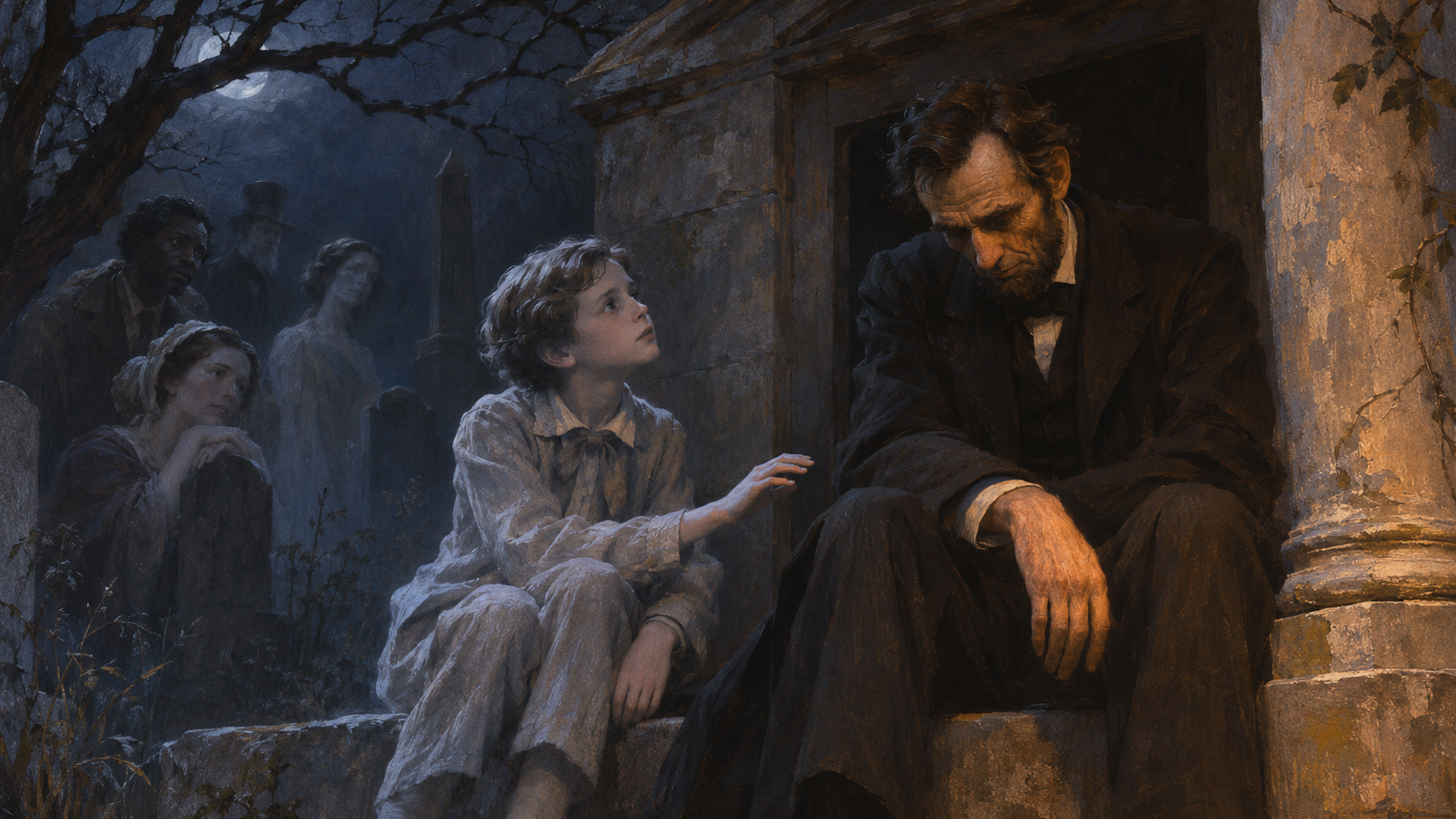
Lincoln in the Bardo received its world premiere at the Metropolitan Opera on October 19, 2026. The Met transmitted the final performance live on its YouTube channel on November 14, and the free replay remained available through November 18. Missy Mazzoli composed the music, and Royce Vavrek wrote the libretto, based on the novel by George Saunders. In Tibetan Buddhism, a bardo is an intermediate state. The one that concerns us here is the interval between death and rebirth.
The opera takes place in 1862 at Oak Hill Cemetery in Georgetown, where Abraham Lincoln’s eleven-year-old son Willie has been laid to rest after dying of typhoid fever. Willie expects his father to come and take him home. Around him are the inhabitants of the bardo. Most believe they are merely ill. They call their coffins “sick-boxes” and pass the time telling stories about the lives they expect to resume.
When Lincoln comes to the crypt at night, he takes Willie’s body in his arms and speaks to him. To the father, it is a farewell. To the boy, it is proof that he was right to wait. Three spirits-Vollman, Bevins, and the Reverend-know what happens to children who linger in the bardo. Afraid that Willie will be trapped there forever, they try to bring father and son together once more.
The Reverend sacrifices himself to free Willie from the tendrils that hold him. In the cemetery chapel, Willie hears his father grieve for him and finally understands that he has died. He tells the other spirits that they, too, are dead. The boy they set out to rescue thus releases many of them from their long vigil. They pass out of the bardo in bursts of light, a phenomenon they call “matterlightblooming.”
As Lincoln mounts his horse, Thomas Havens, the spirit of a Black man, enters his body and rides away with him. Their two voices sound together. Lincoln carries both his grief for Willie and Havens’s experience back to the White House, with the Civil War still to fight and emancipation still ahead.
The Met gave an inferior work a first-rate performance. The singing, playing, and acting were all that one could ask. By the standards of contemporary opera, the piece is about par. The trouble comes when you measure it against the masterpieces that brought audiences to the opera from Mozart to Richard Strauss.
The sets and costumes were imaginative and apposite to the story, at least insofar as I could understand it. The Met lavished considerable resources on a work that I suspect will be a musical footnote a decade or two from now-probably sooner. The company can do justice to an opera soon to be in the bardo. I wish it could do equal justice to the masterpieces of Verdi and his like.
For opera to flourish, it must offer music that moves the listener, music that is beautiful and suited to the emotion of the moment. All nine performances sold out. The question is how many of those listeners will want to hear the piece a second time. Two hours and ten minutes of arid declamation left me without a tune I could recall.
Then there’s the story. Early on we encounter a six-foot-long penis, apparently circumcised, a woman singing a man’s role, and a man singing a girl’s. Ostensibly the opera is about Lincoln’s grief over the death of his son Willie. By my reckoning, that occupies about a third of the action. Much of the rest is given over to the cemetery’s other inhabitants, several of whom could have been left to rest in peace without doing discernible injury to the plot.
The performers were all superior to their material. Peter Mattei looked like Lincoln and delivered his lines with power and musical insight. Christine Goerke was on the mark as the Reverend. His sacrifice frees Willie, though I found what was happening nearly as murky as the stage lighting. Anthony Roth Costanzo was terrific as Miss Elise Traynor. She is meant to show us what happens to a child who overstays her time in the bardo. I found that easier to grasp from the synopsis than from the stage.
Ryan McKinny was very good as Vollman, the fellow with the six-foot-long penis. A falling beam killed him before he could consummate his marriage, and he carries the evidence of his unfulfilled desire into the afterlife. If you’re laughing, it’s even funnier in the flesh. The rest of the cast was first-rate. Too bad they didn’t have more to work with.
The stage was pretty dark, though one could make out the tendrils that spent much of their time moving Willie about. The Met credits three performers as tendrils and seven more as puppeteers. The stage business was expertly managed. Yannick Nézet-Séguin, the Met’s music director, did as much as he could with the score. The two acts struck me as severely unbalanced. The first ran about 85 minutes, the second about 45. The first felt longer still.
I doubt the Met is going to erase its deficit with this opera.
Cast – Metropolitan Opera, November 14, 2026
Abraham Lincoln – Peter Mattei
Willie Lincoln – Everett Sobers
The Reverend – Christine Goerke
Vollman – Ryan McKinny
Bevins – Jonah Hoskins
Miss Elise Traynor – Anthony Roth Costanzo
Thomas Havens – Joshua Blue
Mrs. Baron – Stephanie Blythe
Mr. Baron – Craig Colclough
Mrs. Francis Hodge – Janai Brugger
Litzie – Viviana Goodwin
Lieutenant Stone – Daniel Clark Smith
Ginger Chap from Maine – Christopher Job
Doodling Pennsylvanian – Scott Scully
Gilberts – Ned Hanlon, Eric Lindsey, Dustin Lucas, Remy Martin, Anthony Reed, Gregory Warren
Tendrils – Kathleen Felty, Patrick Miller, Juliet Papadopoulos
Puppeteers – Nikki Calonge, Will Gallacher, Dorothy James, Joseph Lymous, Rowan Ian Seamus Magee, Justin Otaki Perkins, Jon Riddleberger
Music and production team
Composer – Missy Mazzoli
Librettist – Royce Vavrek
Source novel and broadcast introduction – George Saunders
Conductor – Yannick Nézet-Séguin
Stage director – Lileana Blain-Cruz
Chorus director – Tilman Michael
Sets – Adam Rigg
Costumes – Montana Levi Blanco
Lighting – Yi Zhao and Stacey Derosier
Projections – Hannah Wasileski and Hana S. Kim
Choreography – Raja Feather Kelly
Sound – Kate Marvin
Creature suits and puppets – James Ortiz
Illusions and special effects – Jeremy A. Chernick
Dramaturg – Paul Cremo
Co-commissioned by the Metropolitan Opera and Santa Fe Opera
Co-produced by the Metropolitan Opera and the Indiana University Jacobs School of Music
Comments
Loading