Quacks at the Opera
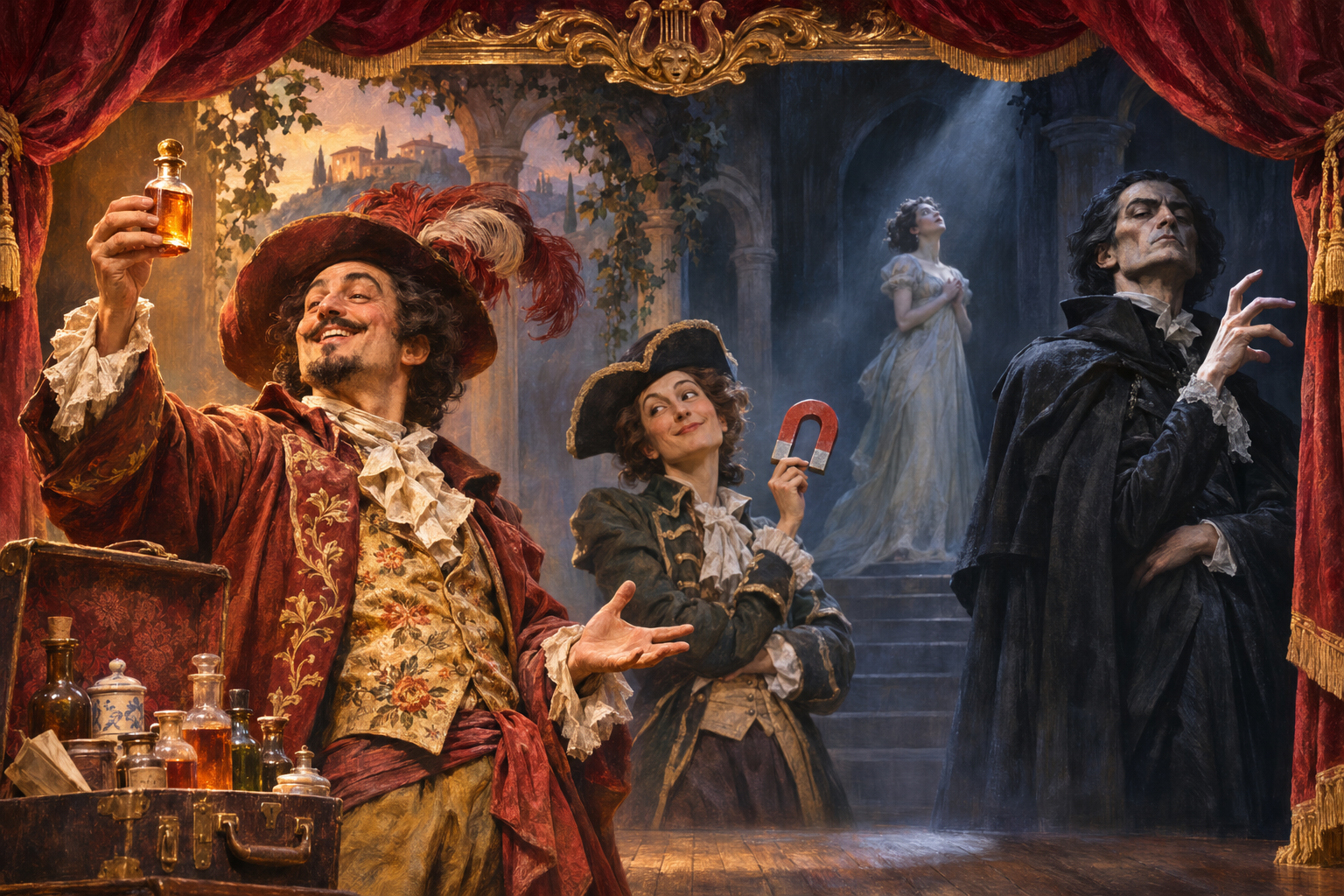
I had to dig a little deeper than usual to come up with seven operas that feature evil or crooked doctors. Four of the seven are in the standard repertory, but the other three are rare birds.
Medicine offers the dramatist an unusually useful form of license. A doctor can enter a stranger’s house, demand intimate disclosures, prescribe disagreeable remedies, and expect payment for his treatment. The impostor needs only to reproduce the outward signs of medical authority. Opera has exploited the possibilities with enthusiasm, though its fraudulent healers range from cheerful schemers to agents of death. These seven, considered in the order of their operas’ premieres, show how widely the same theatrical device can vary.
In Mozart’s Così fan tutte (1790), Despina briefly exchanges her position as a servant for the authority of a physician. Ferrando and Guglielmo, disguised as foreign suitors, pretend to poison themselves after their advances are rejected. Despina arrives in medical disguise and revives them with a magnet, a comic invocation of the then fashionable claims of animal magnetism. The patients are shamming, the physician is an impostor, and the treatment is a performance. The only people who believe they are witnessing a medical emergency are the two women whose fidelity is being tested.
Despina’s fraud belongs to the opera’s larger examination of how readily appearances command belief. Her employers would scarcely accept medical advice from their maid, but costume and professional manner make the same woman credible. Mozart gives the deception the bustle and animation of ensemble comedy. Nobody needs healing, and nobody is physically injured. Yet the harmlessness of the medical episode does not make the experiment surrounding it harmless: the fictitious poisoning is another means of manipulating real emotions.
Donizetti’s L’elisir d’amore (1832) supplies the most complete commercial quack of the group. Dr Dulcamara arrives with a sales pitch whose exuberance is matched only by the scope of his therapeutic claims. His entrance aria, “Udite, udite, o rustici,” turns advertising into musical theatre. When Nemorino asks for the love potion associated with Tristan and Isolde, Dulcamara instantly accommodates the demand with ordinary wine. He prudently explains that the medicine requires time to work, allowing its vendor to be elsewhere when disappointment arrives.
Dulcamara’s success depends on his understanding of desire. Nemorino wants hope badly enough to buy it, and wine supplies a temporary confidence that sober reasoning has failed to provide. Subsequent events make the transaction look astonishingly effective: an inheritance attracts the village women, while Adina acknowledges her love. The sincerity of her love always comes with a question mark given its proximity to its sudden acquisition of wealth of which she is supposedly unaware. , Dulcamara can therefore collect credit for benefits his medicine did not produce. Donizetti’s comedy captures a twofold advantage enjoyed by the charlatan: improvement can be claimed as proof, while failure can be postponed until after departure.
Bizet’s Le Docteur Miracle is a one-act opéra-comique composed in 1856 when Bizet was just 18 years old. It presents medical imposture as an instrument of courtship. Silvio, a young officer in love with Laurette, must overcome her father’s opposition. Disguises provide his solution. Appearing as the servant Pasquin, he prepares an omelet that the family subsequently believes to have been poisoned. He then assumes the identity of Doctor Miracle and offers the necessary cure, making the father’s consent to the marriage the price of salvation. The emergency and its remedy belong to the same invention.
Here the physician’s authority rests chiefly on fear. The father who will not listen to a lover becomes receptive when his own survival appears to be at stake. Bizet treats the affair with the lightness appropriate to a youthful comic work; the omelette receives an ensemble of a dignity quite disproportionate to its culinary merits. Silvio is a medical fraud, but his practice has one patient, one contrived crisis, and one matrimonial objective. Once he obtains the bride, he has no reason to continue his professional career.
Gounod’s Le Médecin malgré lui (1858), based on Molière’s play of the same name (The Doctor in spite of himself) is an opéra comique in three acts set to a libretto by Jules Barbier and Michel Carré. It gives its impostor an unusual excuse: he is beaten into becoming a doctor. Sganarelle is a woodcutter whose wife, Martine, takes revenge for his brutality by telling two men in search of a physician that her husband is a distinguished practitioner who will deny his profession until properly thrashed. The treatment works. Having discovered the physical disadvantages of telling the truth, Sganarelle accepts his new qualification and proceeds to exercise it.
His patient, Lucinde, is pretending to be mute because her father opposes her chosen marriage. An invented physician thus confronts an invented illness, and the supposed cure advances the lovers’ plans. Sganarelle’s medical explanations parody the use of learned language to conceal ignorance. Gounod’s music gives grace and movement to a comedy whose central joke is thoroughly ungracious toward professional pretension. Sganarelle does not acquire knowledge; he discovers that a confident manner can often spare him the need for it.
With Dr Miracle in Offenbach’s Les Contes d’Hoffmann (1881), medical imposture becomes lethal. This Miracle has nothing of Bizet’s resourceful young lover. He belongs to the succession of sinister figures who frustrate Hoffmann’s loves, and his intervention in Antonia’s life is openly destructive. Antonia possesses a beautiful voice but suffers from an illness that makes singing dangerous. Her father, Crespel, already associates Miracle with the death of her mother. His arrival promises a repetition of that disaster rather than relief.
Miracle exploits Antonia’s longing for artistic fulfillment and her attachment to her dead mother. By conjuring the mother’s voice, he draws her into the singing that kills her. The scene gives the musical art on which opera itself depends a terrible dramatic function: beauty becomes the means of destruction. Miracle is beyond ordinary quackery. He does not merely offer an ineffective remedy or misunderstand an illness. He uses his knowledge of the patient’s vulnerability to bring about precisely the outcome a physician should prevent.
The unnamed Doctor in Berg’s Wozzeck (1925) is equally disturbing because he needs no supernatural powers. He is an actual physician. This doctor is the operatic precursor to Dr Mengele. He pays Wozzeck to submit to dietary experiments and regards Wozzeck’s bodily functions as matters subject to his professional command. When his subject displays mental disturbance, the Doctor responds with scientific excitement. Suffering becomes interesting material, and the prospect of a notable observation displaces concern for the sufferer.
The Doctor’s wrongdoing is therefore different from Dulcamara’s. The salesman exploits belief in a cure; Berg’s physician exploits economic dependence and the prestige of research. Wozzeck needs the money and cannot meet him on equal terms. Berg preserves something grotesquely comic in the Doctor’s pomposity, but the comedy offers little relief. This is medicine emptied of responsibility toward the person undergoing treatment. The patient’s deterioration can count as the investigator’s success.
Czech composer Pavel Haas’s Šarlatán (The Charlatan, 1938) is a tragicomic opera in three acts and seven scenes set to a libretto by Haas. It returns to the travelling practitioner but makes him a tragic and ambiguous figure. Dr Pustrpalk moves through the world with entertainers whose performances accompany his medical activities. Healing, salesmanship, and show business occupy the same precarious stage. He enjoys public acclaim, but his fortunes reverse when a sick monk dies during an operation and the crowd suspects murder. The audience that welcomed a wonder-worker is ready to condemn a killer.
Pustrpalk complicates any easy division between the fraudulent healer and the misunderstood practitioner. Haas allows him aspiration and insight as well as theatricality and dubious methods. His downfall ends in drink, isolation, and death. Coming last in this sequence, he prevents the subject from settling into a simple progression from amusing fraud to medical villainy.
Despina’s magnet, Dulcamara’s bottle, Miracle’s fatal persuasion, and the Wozzeck Doctor’s experiments all exploit the authority of healing. Pustrpalk adds the uncomfortable possibility that the man claiming that authority may himself be unable to distinguish his gifts from his delusions.
Offenbach’s Dr Miracle deserves special attention — he is arguably the most evil character in all of opera. He has no grievance to avenge and no injury to plead in excuse for his cruelty. He is the personification of evil. Even Iago can cite being passed over for promotion for his awful actions. Berlioz’s, Gounod’s, and Boito’s devils have a veneer of charm over their inherent evil.
Comments
Loading