Comprimari
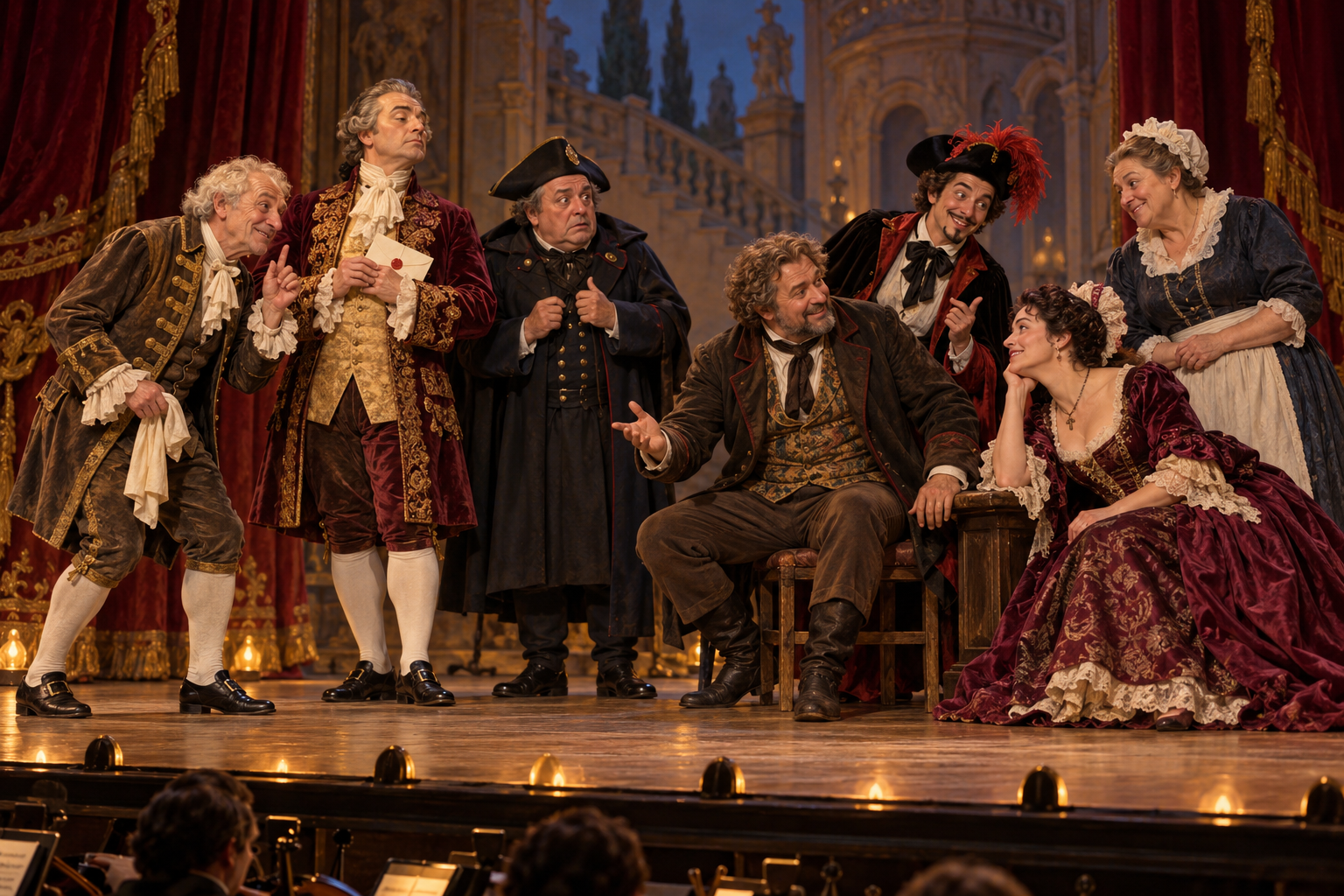
A comprimario, or comprimaria in the feminine, is an opera singer who performs supporting roles. The designation describes an assignment or a professional specialty, not a lower standard of musicianship. These singers portray the servants, confidantes, courtiers, messengers, and officials who give an opera its social setting and help its action unfold. Some have only a handful of phrases; others have substantial scenes or an aria. Several distinguished specialists also sang leading roles, particularly early in their careers, but their lasting reputations rest on what they accomplished outside the spotlight.
The demands of this kind of work are easily underestimated. A principal singer may have an entire evening to establish a character. A comprimario sometimes has less than a minute. Clear diction, rhythmic accuracy, an understanding of dramatic relationships, and the ability to make an entrance count are essential. So is restraint. A supporting artist must register distinctly without upsetting the proportions of the scene. The best can make a few words memorable while keeping the audience’s attention directed toward the drama.
Among the richest opportunities are the four character-tenor roles in Offenbach’s The Tales of Hoffmann: Andrès, Cochenille, Frantz, and Pitichinaccio. Conventionally called the four servants, they are frequently assigned to one singer. Andrès serves Stella, Cochenille assists Spalanzani, Frantz attends Crespel, and Pitichinaccio inhabits Giulietta’s Venetian world. Their successive appearances allow a performer to create a series of contrasting portraits within the opera’s shifting mixture of comedy, fantasy, and menace.
Frantz has the most conspicuous solo opportunity. His comic song exposes the distance between his artistic aspirations and his abilities. Making this funny requires considerable accomplishment: the performer must suggest a deficient singer and dancer while retaining control of rhythm, pitch, diction, and movement. Mere buffoonery quickly becomes tiresome. The comedy is sharper when the musical foundation remains sound.
Below are a few brief biographical sketches of some of the best- known comprimario singers of the last one hundred years. Those who sang at the Met were often cast in the performances I attended there. Their professionalism contributed greatly to the success of the operas in which they appeared. There are many more fine comprimario performers than I have listed here.
Piero de Palma (1925-2013) was among the finest practitioners of this exacting profession. His voice possessed the brightness and focus that allowed a short phrase to emerge clearly from an ensemble. His diction gave the words immediate definition, and his characterizations remained recognizably sung. For collectors of complete Italian opera recordings, his name became almost a guarantee that the smaller tenor parts would receive proper attention. His repertory included Goro in Madama Butterfly, Spoletta in Tosca, Gastone in La Traviata, Borsa in Rigoletto, Cassio in Otello, Dr. Caius in Falstaff, and Spalanzani in Hoffmann.
These assignments reveal the range concealed within the term comprimario. Goro’s commercial calculations, Spoletta’s anxious subservience, and Cassio’s youthful attractiveness require different vocal and theatrical treatment. De Palma himself distinguished brief supporting parts from substantial second-tenor roles such as Prunier in La rondine and Malatestino in Francesca da Rimini. He could perform across that range. His career demonstrates how misleading it is to measure a singer’s importance solely by the size of the lettering on a poster.
Alessio de Paolis (1893-1964) brought comparable distinction to an earlier generation. After singing principal tenor parts, he became a master of characterization whose musical intelligence and theatrical versatility made him invaluable. His importance was recognized well beyond the affection normally accorded a dependable company member: the Italian biographical dictionary Treccani’s Dizionario Biografico degli Italiani places him among the greatest comprimarios the operatic stage has known.
The four servants in Hoffmann were a particularly suitable outlet for his gifts. A review preserved in the Met archives praised the dramatic skill of his portrayal even when his vocal resources had diminished. That observation identifies one of the profession’s distinguishing features. Experience can deepen a characterization even after a singer’s vocal resources have begun to diminish. Timing, inflection, and the understanding of a character’s relationship to others can keep an artist theatrically persuasive.
Charles Anthony (1929-2012) gave this profession an extraordinary example of sustained service. Between 1954 and 2010 he appeared in 2,928 Metropolitan Opera performances. His frequent assignments included the Innkeeper in Der Rosenkavalier, Ruiz in Il Trovatore, Gastone, and Spoletta. Although he occasionally undertook leading roles, his enduring contribution was the consistency with which he enlivened supporting ones.
Such longevity meant working with successive generations of stars, conductors, and directors. The supporting singer had to accommodate different tempos, dramatic emphases, and stage personalities while preserving the identity of his own character.
Paul Franke (1917-2011) supplied another version of that virtue. He sang 1,980 Met performances, with Spoletta his most frequent role. His repertory also included larger character assignments, among them David in Die Meistersinger, Shuisky in Boris Godunov, and the Witch in Hansel and Gretel. His versatility encompassed comedy, uneasiness, and outright malice.
Recordings preserve a gentler side of his art. As Beppe in the 1953 Pagliacci with Jussi Björling, Victoria de los Ángeles, Leonard Warren, and Robert Merrill, Franke contributes to an unusually distinguished ensemble. Beppe’s serenade, sung as Arlecchino during the players’ theatrical entertainment, requires genuine lyric grace. It is a small but revealing test: a character tenor must be able to produce an attractive musical line when the score calls for one.
Anthony Laciura, born in 1951, continued this tradition with a particularly strong theatrical presence. His Met repertory included the four servants and Spalanzani in Hoffmann, Goro, Spoletta, Beppe, Monsieur Triquet in Eugene Onegin, and the Simpleton in Boris Godunov. These characters require much more than a collection of amusing mannerisms. Triquet’s social performance and the Simpleton’s exposed vulnerability belong to very different emotional worlds.
Laciura’s Frantz illustrates the value of preserving musical standards in comic work. A 1992 Los Angeles Times review specifically commended the singing in his portrayal. The distinction is fundamental. Characterization should emerge through the music; when vocal distortion becomes a substitute for interpretation, both the character and the composer suffer.
The female supporting repertory often calls for a less conspicuous kind of theatrical skill. Companions and confidantes must listen convincingly, respond to danger, and establish relationships upon which the audience’s understanding depends. Thelma Votipka (1906-1972) – the standees called her Tippie – was a major representative of this tradition. Her 1,422 Met appearances included Giovanna in Rigoletto, Marthe in Faust, Alisa in Lucia di Lammermoor, Frasquita in Carmen, and Mamma Lucia in Cavalleria Rusticana.
These women occupy different positions within their operas. Frasquita contributes to the energy and precision of ensemble comedy. Alisa gives Lucia’s apprehensions an immediate human audience. Mamma Lucia supplies the domestic and emotional foundation of Mascagni’s tragedy; Turiddu’s final farewell depends partly on the mother who receives it. The supporting singer’s attentive silence can matter almost as much as her vocal response.
Carlotta Ordassy (1921-2006) brought substantial musical preparation to similar work. She placed second to Victoria de los Ángeles at the Geneva competition in 1947, studied with Gina Cigna, and made her professional debut at La Scala under Otto Klemperer. At the Met she became a familiar Alisa, Giovanna, Ines in Il Trovatore, Curra in La Forza del Destino, Clotilde in Norma, and Priestess in Aida. Her record included 118 performances as Alisa and 109 as Giovanna.
These singers gave opera something that a gathering of famous voices alone cannot supply: a convincing population. Their artistry made the stage feel inhabited beyond the principal characters. They could sharpen a joke, deliver a threat, sustain an ensemble, or make a moment of grief believable. Their names might appear in smaller type, but the quality of a performance often depended on their presence.
Comments
Loading