Cancer Statistics 2026

Every January the American Cancer Society releases the latest data about cancer in the United States. The full report can be downloaded below. As is typical for the society their press release highlights the increase in cancer survival. Below is a quotation from an article in the lay press:
The five-year cancer survival rate in the US has reached 70% for the first time, according to an American Cancer Society report released yesterday. The figure, based on diagnoses from 2015 to 2021, is up from 49% in the mid-1970s and 63% in the mid-1990s.
While everyone should be pleased with this news, survival rates are difficult to interpret because of a built-in bias. This bias has two components. First is overdiagnosis. There are forms of cancer that are very likely never to kill the patient afflicted by them. Two examples of such tumors are certain forms of breast cancer in women and prostate cancer in men. Note I’m writing about just a subset of these cancers which, of course, can be lethal in other guises.
The second component of survival bias is that due to early diagnosis. Consider a patient who develops a cancer so virulent that it will kill him in 10 years regardless of whatever therapy he receives. If he is diagnosed after having the disease for one year, his survival is 9 years. If the diagnosis is not made until after nine years, his survival is obviously one year. Early diagnosis in this example increases survival time from one year to nine, but the patient has not benefited from this example of early diagnosis.
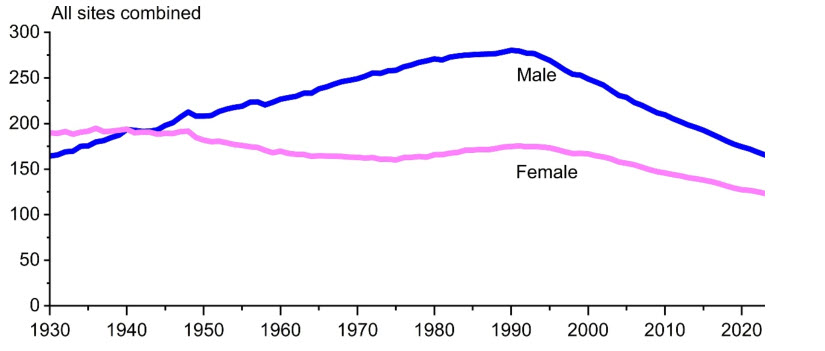
This bias is why the best way to look for progress in the diagnosis and treatment of cancer is age-adjusted mortality. The report presents these data. They are reproduced just below this paragraph. First, overall mortality rates in men and women. Trends in cancer incidence (1975–2022) and mortality (1975–2023) rates by sex, United States. Rates are age-adjusted to the 2000 US standard population, and incidence rates are adjusted for delays in case reporting. Incidence data for 2020 are shown separately from trend lines. As you can see, overall cancer mortality has decreased substantially over the past 45 years.

Next, look at trends in cancer mortality rates by sex overall and for selected cancers by sex, United States, 1930–2023. Rates are age-adjusted to the 2000 US standard population.
Mortality over the same span is presented in males. The rates for various cancers are displayed.
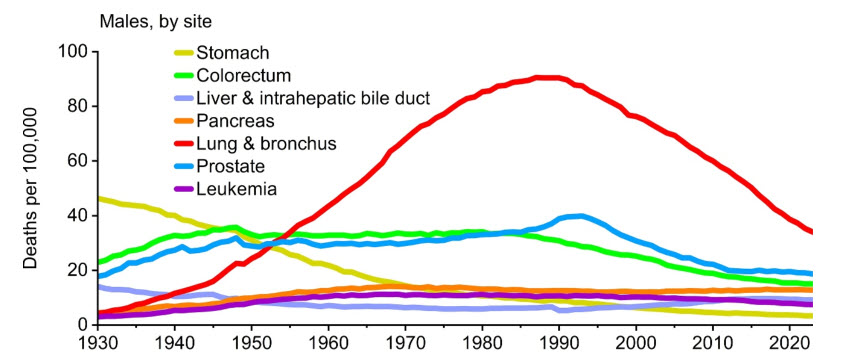
The decline in lung cancer deaths is almost entirely due to smoking cessation. The prostate cancer death rate is exactly the same as it was in 1930 despite the enormous increase in prostate cancer diagnosis secondary to PSA testing. The rise and fall of the death rate for this disease in the interval between 1930 and 2000 is still unexplained. Colorectal cancer mortality has fallen substantially, though it too is only slightly lower than 1930.
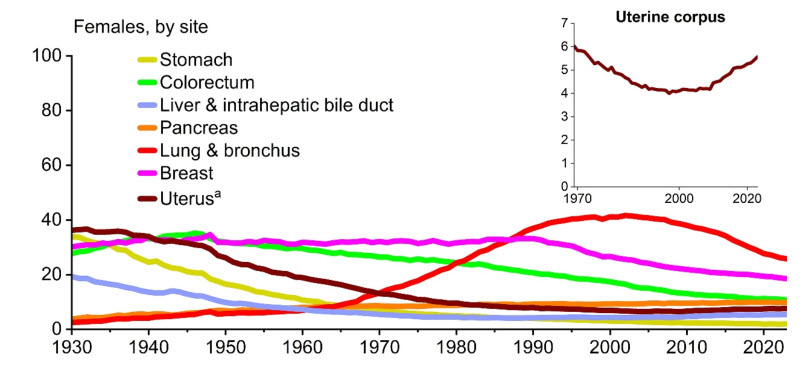
The same data for women are presented next. The fall in lung cancer deaths is again due to smoking cessation. The fall in breast cancer mortality could be due to better treatment as widespread mammography screening started before the fall in moratlity. However, it did not reach current levels until close to 1990, so mammography may play a role in the decline in the death rate as well. Colorectal mortality has fallen substantially over the last century, strongly suggesting that widespread screening for the disease may be effective.
The entire report is full of useful information and can easily be read and understood by an interested layman. It’s only 29 pages long, excluding references.
Comments
Loading