Ombra Mai Fu

“Ombra mai fu”, also known as “Largo from Xerxes” or “Handel’s Largo”, is the opening aria from the opera Serse (1738) by George Frideric Handel. Serse is an opera seria in three acts. It was first performed at the King’s Theatre, Haymarket on 15 April 1738. It was a complete failure lasting for only five performances. The opera was ignored until 1924 when it was revived in Göttingen. It has since become Handel’s most performed opera after Giulio Cesare.
Originally composed to be sung by a soprano castrato (and typically sung in modern performances of Serse by a countertenor, contralto or a mezzo-soprano; sometimes even by a tenor or high baritone an octave below), it has been arranged for other voice types and instruments, including solo organ, solo piano, violin or cello and piano, and string ensembles, often under the title “Largo from Xerxes“. The aria became popular as a recital piece in the 19th century. Today, singers of all flavors sing it in an arrangement suitable for their vocal type.
The aria has the distinction of being the only one, as far as I know, fondly devoted to a plant. The Italian and English words are at the end of this piece.
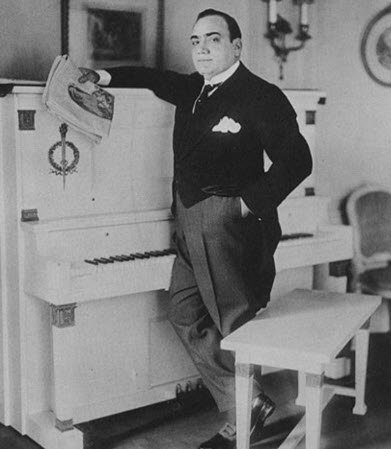
I’ll begin with the oldest recording of the piece in this collection. Enrico Caruso performed the aria in 1920, the last year of his career. He sounds like a fully developed dramatic tenor ready for Verdi’s Otello, though the singing is sensitive and subtle. Note that he has the trill that’s in the score. Some of the tenors below omit it. This recording probably comes closest to what the tenor sounded like in performance. Ombra mai fù.
Today’s countertenors likely sound nothing like the castrati of the 18th century whose sound was likely larger and better supported. Andreas Scholl does a reasonably good job with the aria.
Dmitri Hvorostovsky was only 26 when the video below was made. He sounds very good, but has not yet reached the zenith of his power.
Beniamino Gigli was 43 years old when the film of his singing of the aria in a recording studio was made. His lyric tenor is in fine form.
Cécilia Bartoli performs Handel’s aria as a stylized set piece.
Placido Domingo has recorded everything except the Beijing phone directory, and that omission is only because he couldn’t get a copy.
José Carreras had one of the most beautiful voices of the last century until leukemia and oversinging diminished it. This recording was made early in his career.
Finally, Franco Corelli gives a superb reading of Handel’s famous aria.
Frondi tenere e belle
del mio platano amato
per voi risplenda il fato.
Tuoni, lampi, e procelle
non v’oltraggino mai la cara pace,
né giunga a profanarvi austro rapace.
Ombra mai fu
di vegetabile,
cara ed amabile,
soave più.
Tender and beautiful fronds
of my beloved plane tree,
let Fate smile upon you.
May thunder, lightning, and storms
never disturb your dear peace,
nor may you by blowing winds be profaned.
Never was a shade
of any plant
dearer and more lovely,
or more sweet.
Comments
Loading