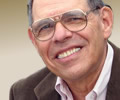
Nicolae Herlea (1927- 2014) was a distinguished Romanian baritone. He was admired for the burnished warmth of his voice, impeccable legato, and aristocratic stage bearing. Though he built a substantial international career, he remained deeply associated with the Romanian operatic tradition and is widely regarded as one of his country’s greatest vocal artists.
Herlea studied at the Bucharest Conservatory, where he trained under the celebrated Romanian baritone Aurel Costescu-Duca. His voice was soon recognized as a Verdi baritone – rich, darkly colored, and capable of expansive phrasing without sacrificing clarity of diction.
He made his professional debut in 1951 at the Romanian National Opera in Bucharest, quickly establishing himself as a leading baritone in the company. Unlike many singers of his generation from Eastern Europe, whose international mobility was often limited because of the Cold War, Herlea succeeded in making a significant career outside of Romania.
In 1956 he appeared at the Bolshoi Theatre in Moscow, and soon after at La Scala in Milan. He also sang at the Vienna State Opera, the Paris Opéra, and other major European houses. He made his debut at the Metropolitan Opera in New York in 1964 as Posa in Verdi’s Don Carlo. He was very well received in that role. His appearance as Rigoletto was not well reviewed. The problem was felt to be a lack of emotional commitment.
His signature role was Figaro in Rossini’s Barber (though Rigoletto was his favorite). He is said to have sung the role (Figaro) 550 times. His reviews at the Met in the part were lukewarm. He gave a total of only 24 performances with the company. By May of 1966 he was gone, never to return.
When listening to Herlea’s recordings, it’s hard to understand why he didn’t make a bigger impact at the Met. His voice is rich, virile, and well-produced over its entire range. His top notes are ringing and secure. His voice, from what I hear, places him at or near the top of the Verdi baritones of his time. Perhaps the presence of Robert Merrill, Cornell MacNeil, and Sherrill Milnes at the Met convinced General Manager Rudolf Bing that he had enough great local baritones without importing another from Romania.
Herlea’s repertoire centered primarily on Verdi, whose baritone roles suited him ideally. Among his most celebrated portrayals were Rigoletto, the elder Germont in La traviata, Di Luna in Il trovatore, Renato in Un ballo in maschera, and Amonasro in Aida.
He also excelled in verismo operas and the French repertoire, including roles such as Escamillo in Carmen and Valentin in Gounod’s Faust.
Herlea’s voice was distinguished less by sheer dramatic force than by tonal beauty and expressive control. The timbre was smooth and evenly produced throughout his range, with a smooth legato that was well suited to Verdi’s long, arching phrases. His interpretations tended toward dignity and musical refinement rather than overt theatrical excess which may explain the reaction of some of the New York critics.
The video below with soprano Marina Krilovici is the duet ‘Dunque io son’ from Rossini’s The Barber. It appears to be lip-synched. Nevertheless, it’s well sung. The Romanian soprano was a distinguished singer who sang across Europe. She appeared five times at the Met. She defected from Romania and lived in Germany.
‘Largo al factotum’ is sung with panache and plenty of voice. It’s hard to understand what the New York critics found lacking.
‘Cortigiani, vil razza dannata’ is the core aria from Rigoletto. Herlea has all the voice needed for this most demanding of parts, though its explosive beginning is sung with a more restraint than is typical for the piece.
‘Il balen’ from Il Trovatore gets a splendid reading from Herlea. His voice is ideal for Verdi’s beautiful melody.
‘Eri tu’ from Un ballo in maschera shows Herlea’s tendency to smooth over the very intense parts of Verdi’s baritone arias. The introduction to ‘Er u’ is about vengeance. Herlea’s interpretation could use a bit more snarl and bite in the recitative. In the aria he omits the low note near its beginning, raising it an octave.
He sings Verdi’s great duet, ‘Invano Alvaro’, from Forza with Ludovic Spiess, a fellow Romanian. As you’ll hear, Spiess had a very fine and vigorous spinto tenor voice. He suffered a permanent injury to his vocal cords after an international career of 14 years. I do not know the cause or nature of the injury, but it ended his operatic appearances. He became the Romanian minister of culture in the Iliescu government during the 1990s, and later assumed the directorship of the Romanian National Opera, Bucharest from 2001 until 2005. He died the following year.
Herlea’s voice was ideal for the big verismo baritone roles. First the ‘Prologue’ from Pagliacci. Herlea gives a perfect rendition of the famous piece. The two high notes at the end are sensational.
‘Nemico della patria’ from Girodano’s Andrea Chenier is part of every Italian-style baritone’s repertoire. Herlea’s rendition is as good as it gets. Splendid.
The finale to Act 1 of Tosca is a tour de force. Puccini’s villain gets to be as bad as one can be in a church during a service of one’s own religion. Here, Herlea manages to achieve all the required nastiness that the role demands.
Finally, a French aria – ‘Avant de quitter’ from Gounod’s Faust. Valentin’s aria is sung in Romanian.
In Romania, Herlea became a cultural figure of national importance. He was honored with numerous awards and distinctions, and in later years he served as a mentor to younger singers. His long association with the Romanian National Opera made him a central figure in that institution’s postwar history. The beauty of both his voice and artistic termperment place him among the finest baritones of the second half of the last century.